Deriv Tick Trading Strategy: What 10,000 Real Volatility 100 Ticks Showed About Short Trades
Contracts Used for Tick Trading
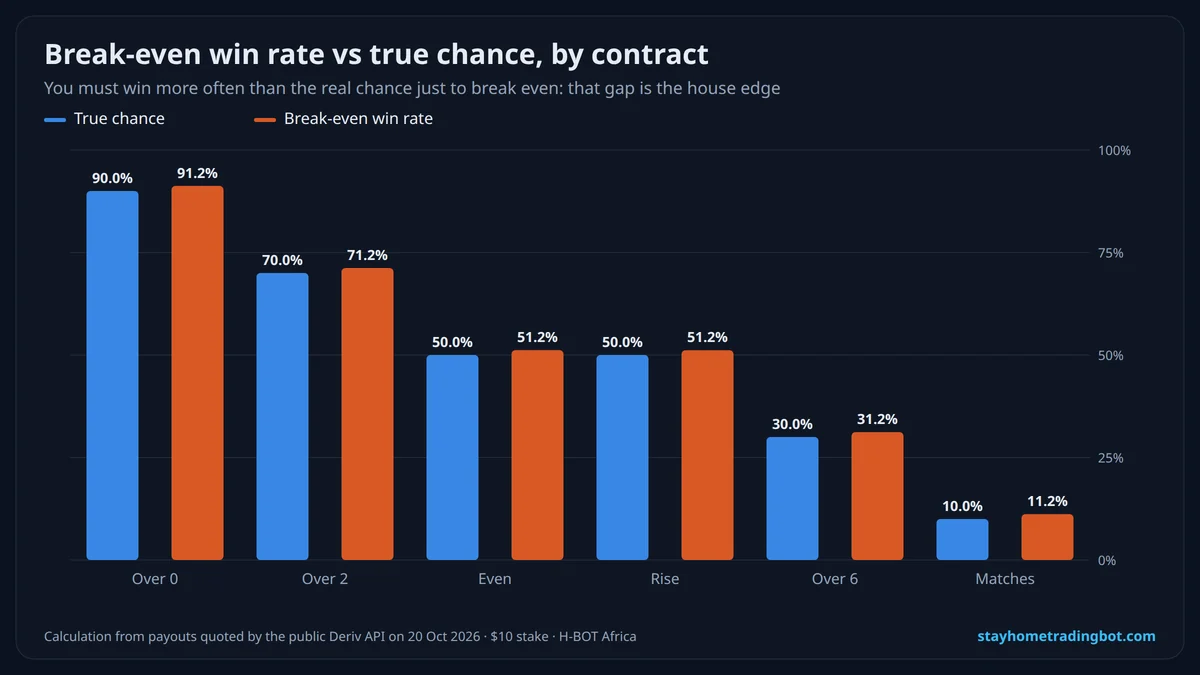
| Contract | Durations | Break-even win rate (20 Oct 2026) |
|---|---|---|
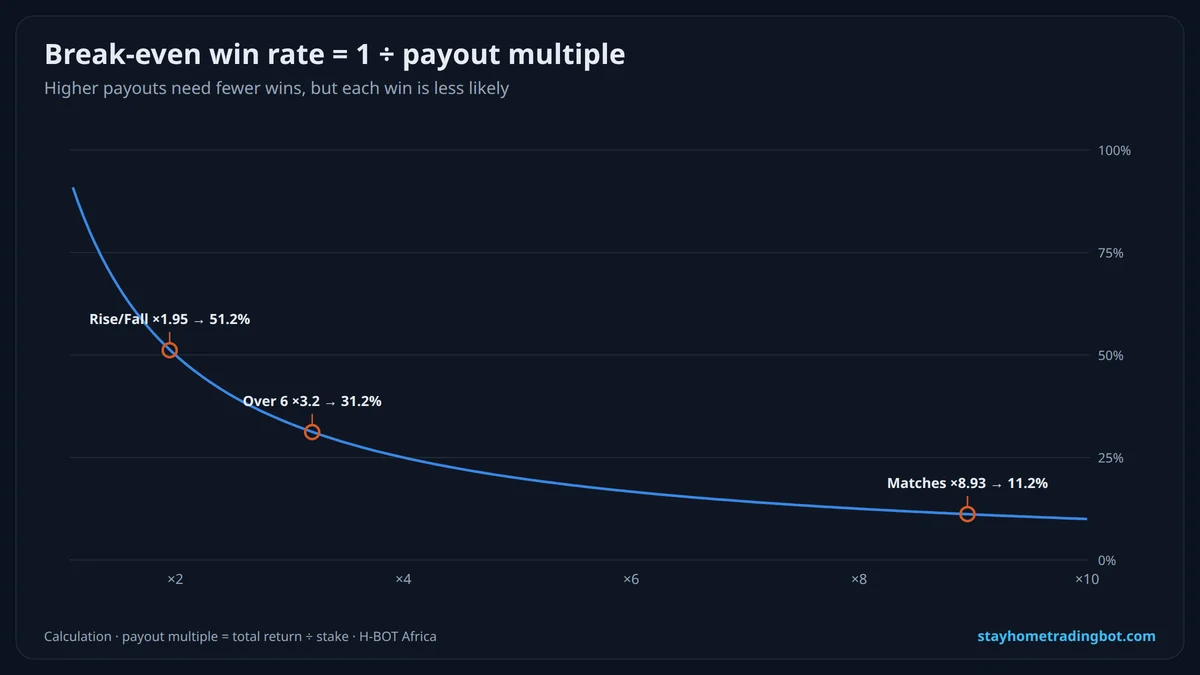
| Rise/Fall | 1–10 ticks | 51.2% |
| Even/Odd, Over/Under, Matches/Differs | 1–10 ticks | 11.2%–91.2% by contract |
| High/Low Ticks | 5 ticks | see contract |
| Only Ups/Only Downs | 2–5 ticks | see contract |
| Touch/No Touch | from 5 ticks | 16.0% / 90.4% for a +0.5 barrier |
The Real-Tick Test
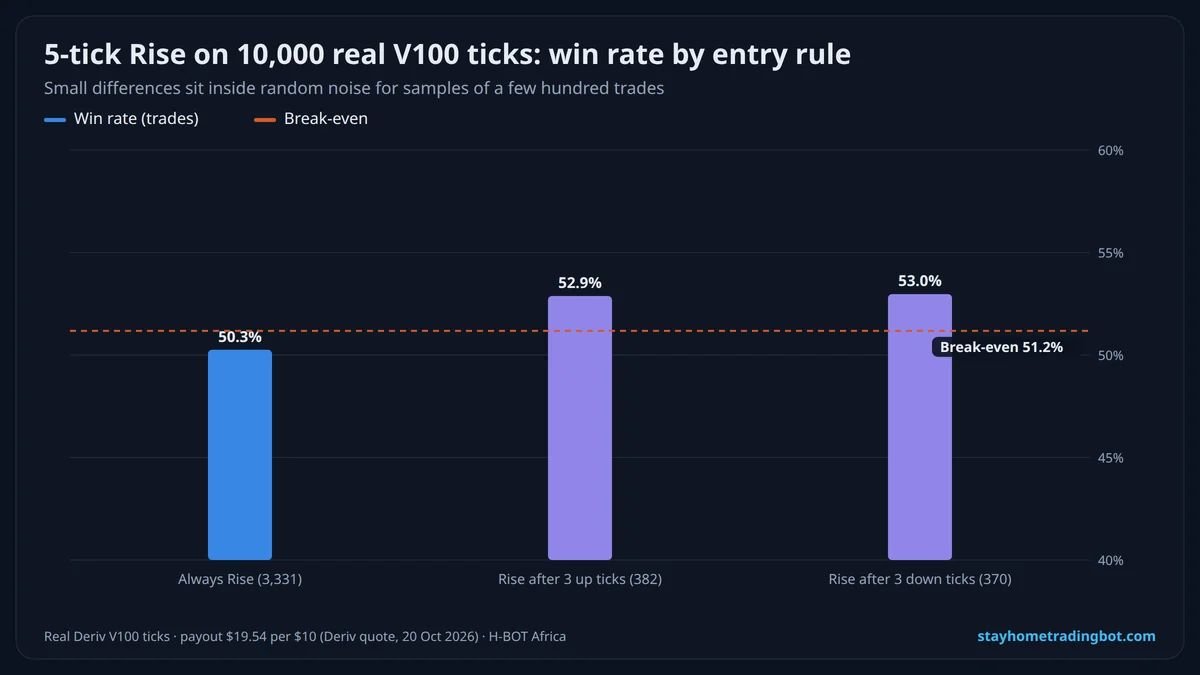
We replayed 10,000 real V100 ticks (about 5.5 hours) and checked every third tick. A trade won when the price 5 ticks later was higher than the entry.
| Entry rule | Trades | Win rate | Result on $10 stakes |
|---|---|---|---|
| Always Rise | 3,331 | 50.3% | −$600 (−1.8%) |
| Rise after 3 rising ticks | 382 | 52.9% | +$127 (+3.3%) |
| Rise after 3 falling ticks | 370 | 53.0% | +$130 (+3.5%) |
Why the “Winning” Rules Are Not an Edge
With about 380 trades, a fair 50% coin can land anywhere between about 45% and 55% just by chance (±2 standard errors, each about 2.6%). Both rules sit inside that band, and they point in opposite directions. Run the same rules on the next 10,000 ticks and they could easily lose. Read how to calculate your win rate for the maths.
If You Still Want to Trade Ticks
- Set a fixed stake (1% of balance) and a maximum number of trades per session.
- Set a daily loss limit, such as 5% of balance, and stop when you hit it.
- Test any tick rule on at least 1,000 demo trades before using real money.
- Use a bot with stop loss and take profit built in ({L("deriv-bot-settings", "bot settings")}); never let it run without limits.
Try It Free on a $10,000 Demo
Open a free Deriv account, connect it to H-BOT Africa and test bots, signals and digit tools on virtual money before risking a shilling.
Open a free Deriv account Open Deriv Bot Open H-BOT Ask on WhatsApp
Have an audience? Become a Deriv partner and earn commission on clients you refer.
Disclosure: some links on this page are Deriv partner links. If you open an account or become a partner through them, H-BOT Africa may earn a commission at no extra cost to you.
Frequently Asked Questions
What is tick trading on Deriv?
Trading contracts that end after a set number of price ticks, from 1 to 10.
What is the best tick strategy on Deriv?
No tick rule beat randomness in our test. Focus on small stakes and limits.
How many ticks should I use for Rise/Fall?
The payout is almost the same for 1 to 10 ticks, so the number of ticks does not create an edge.
Is 5-tick trading profitable?
Always buying Rise lost 1.8% in our test, close to the built-in edge.
How many trades do I need to test a strategy?
At least several hundred, ideally over 1,000, because small samples are dominated by luck.
Can a bot make tick trading profitable?
A bot follows rules faster; it cannot remove the built-in edge.
Related Guides
 NEWDeriv Payout Explained: What Each Contract Pays, the Break-Even Win Rate and the Built-In Edge
 NEWWin Rate in Trading: How to Calculate It, the Win Rate You Need, and How Many Trades Prove It
 Deriv Rise/Fall Strategy: How the Contract Works and How to Trade It Carefully
 NEWVolatility (1s) Indices on Deriv: What “1s” Means, Real Speed Data and Which One to Choose