Boom 1000 and Crash 1000 Index: How Spikes Work, Real Spike Counts and How to Trade Them
How Boom and Crash Indices Work
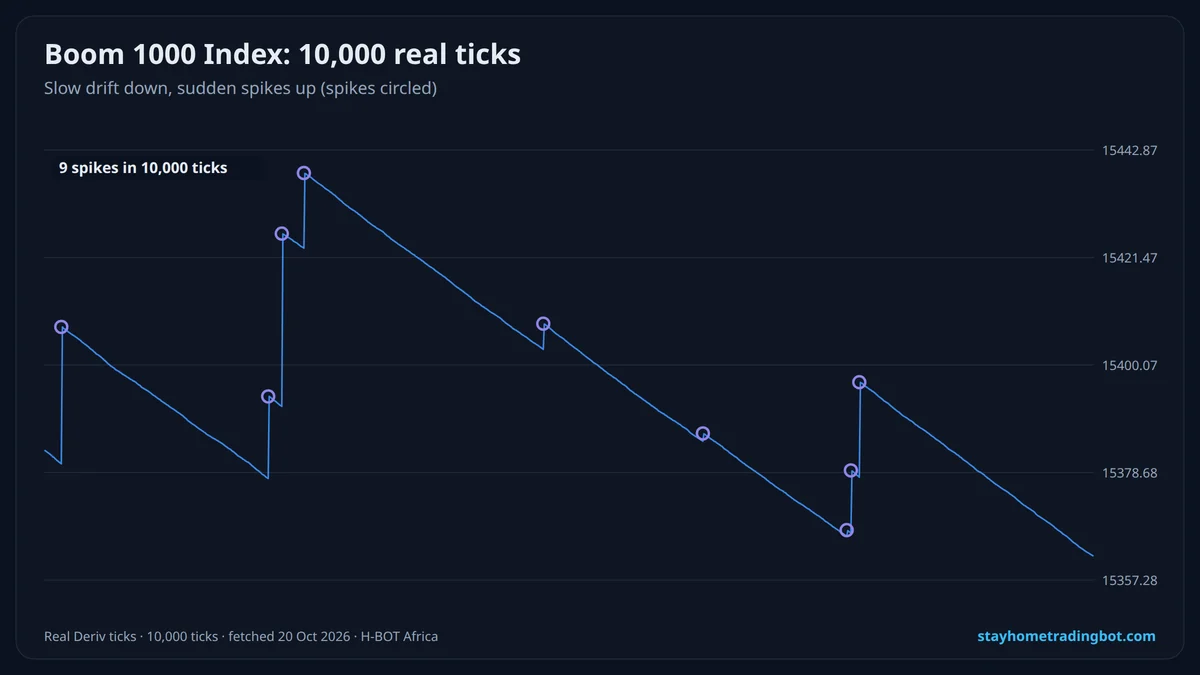
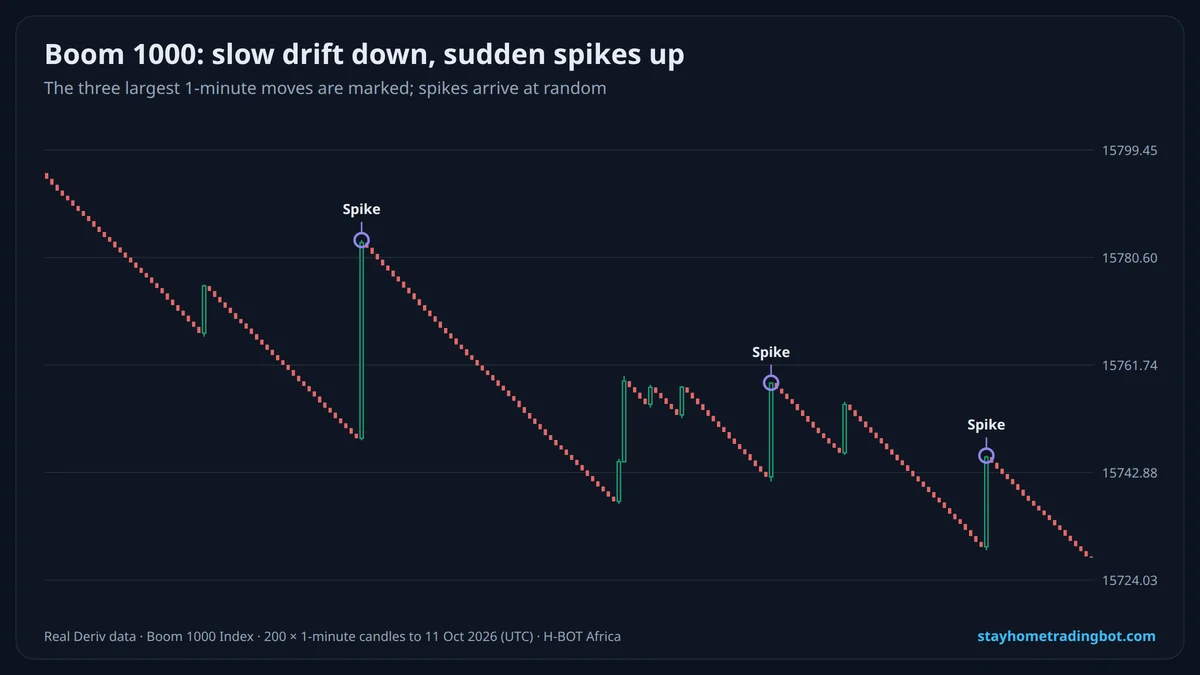
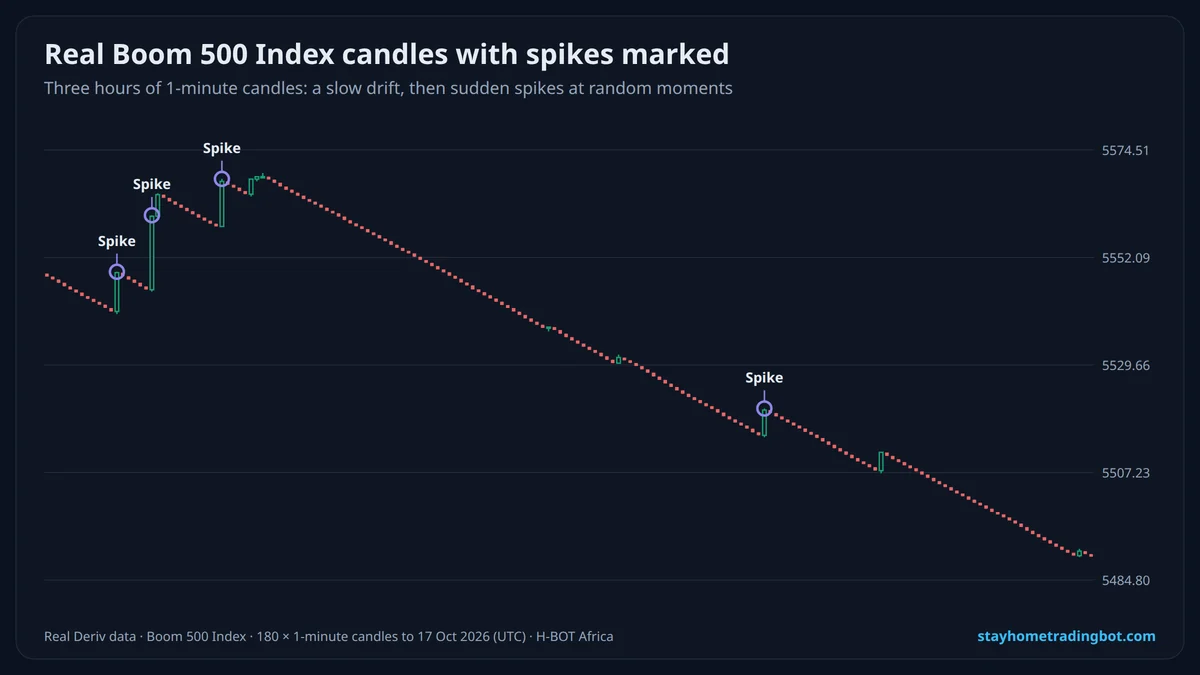
- Boom: small down moves on most ticks, then a big up spike.
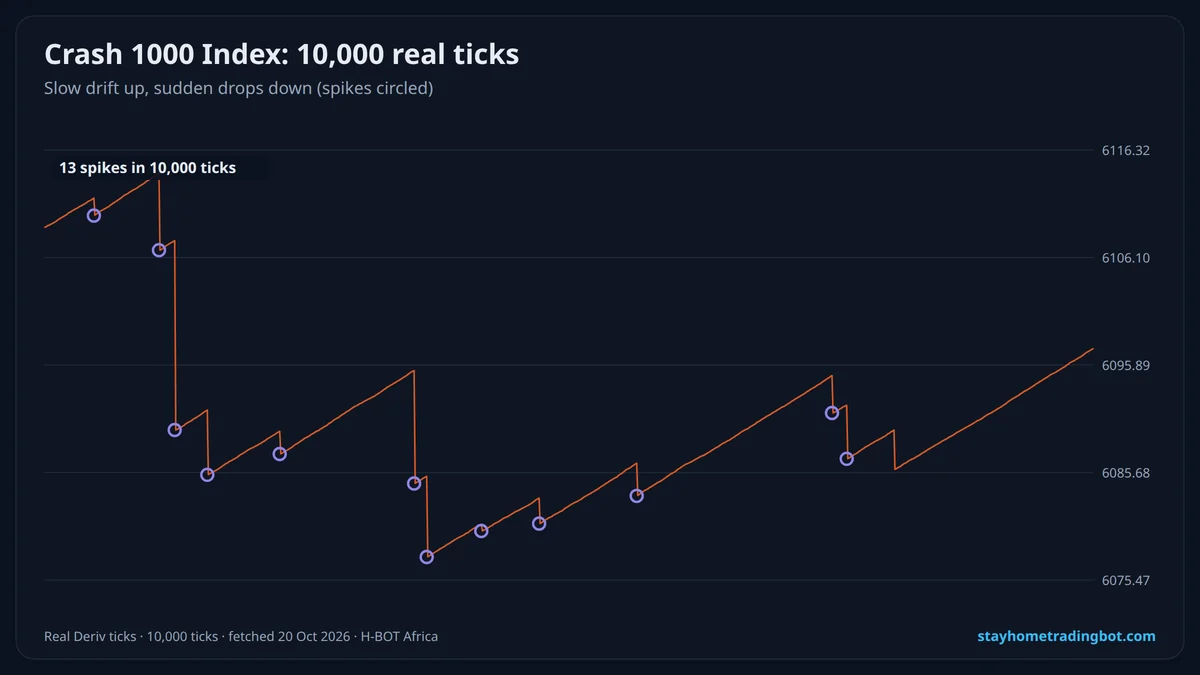
- Crash: small up moves on most ticks, then a big down spike.
- Spikes come at random with a set average frequency. Each tick has the same small chance of a spike.
- They run 24/7, like other Deriv synthetic indices.
Real Spike Gaps on All 14 Boom and Crash Indices
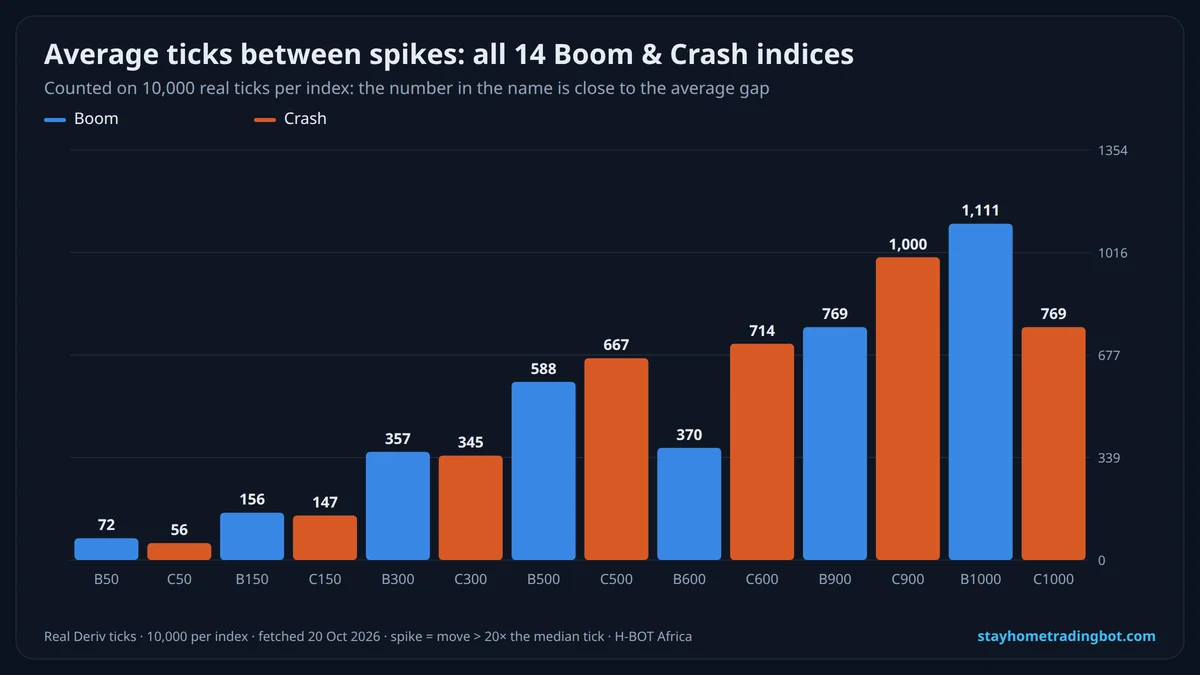
| Index | Spikes in 10,000 ticks | Average gap | Shortest gap | Longest gap |
|---|---|---|---|---|
| Boom 1000 | 9 | 1,111 | 40 | 2,279 |
| Crash 1000 | 13 | 769 | 124 | 1,863 |
| Boom 500 | 17 | 588 | 105 | 1,943 |
| Crash 500 | 15 | 667 | 43 | 1,235 |
| Boom 300 | 28 | 357 | 13 | 1,076 |
| Crash 300 | 29 | 345 | 1 | 928 |
We counted a spike as any tick move more than 20 times the normal tick move. A 10,000-tick sample is small for Boom 1000, so treat the averages as rough; the gaps are the important part: two spikes can come 40 ticks apart, or more than 2,000 ticks apart.
Why “Spike Catching” Is Hard
Many Telegram groups sell “spike catcher” bots that wait for a set number of ticks and then buy. Because each tick has the same chance of a spike, waiting longer does not make a spike more likely. A trader who buys Boom 1000 Up and holds it pays the slow drift down on every tick while waiting.
Contracts Available
| Contract | How it fits Boom/Crash |
|---|---|
| Multipliers | Trade the drift or the spike with stop loss and take profit. A spike against you can jump straight past your stop. |
| Accumulators | Grow a stake while price stays inside a range. A spike usually knocks the contract out. |
A Risk-First Plan for Boom 1000 and Crash 1000
- Practise on demo for at least a week and log every spike you see.
- Use a multiplier with a stop loss, and size the stake so a full stop-out is 1–2% of your balance.
- Set a daily loss limit and stop when you reach it.
- Never add to a losing position “because a spike is due”.
See also our Boom and Crash strategy guide and Boom 500 and Crash 500.
Try It Free on a $10,000 Demo
Open a free Deriv account, connect it to H-BOT Africa and test bots, signals and digit tools on virtual money before risking a shilling.
Open a free Deriv account Open Deriv Bot Open H-BOT Ask on WhatsApp
Have an audience? Become a Deriv partner and earn commission on clients you refer.
Disclosure: some links on this page are Deriv partner links. If you open an account or become a partner through them, H-BOT Africa may earn a commission at no extra cost to you.
Frequently Asked Questions
What is the Boom 1000 index?
A Deriv synthetic index that drifts down and spikes up on average about once every 1,000 ticks.
How often does Crash 1000 spike?
On average about once every 1,000 ticks, but in our real sample gaps ranged from 124 to 1,863 ticks.
Can you predict a Boom 1000 spike?
No. Each tick has the same chance of a spike, so counting ticks does not help.
Which contracts can I trade on Boom 1000?
On 20 October 2026 Deriv offered multipliers and accumulators.
Is Boom 1000 better than Boom 500?
Neither is better. Boom 1000 spikes about half as often as Boom 500.
Do spike catcher bots work?
No bot can know when the next spike will come. Test any bot on demo first.
Related Guides
 Boom and Crash Indices: How the Spikes Work, Strategies People Use and the Real Risks
 Boom 500 and Crash 500 Index: How Often Spikes Come, How to Trade Them and the Risks
 Deriv Multipliers Explained: How They Work, Stop-Out, Deal Cancellation and Safer UseDeriv Accumulators Explained: Growth Rate, Barriers, Take-Profit and Risk