Max Drawdown in Trading: What It Means, How to Calculate It and What Is Acceptable
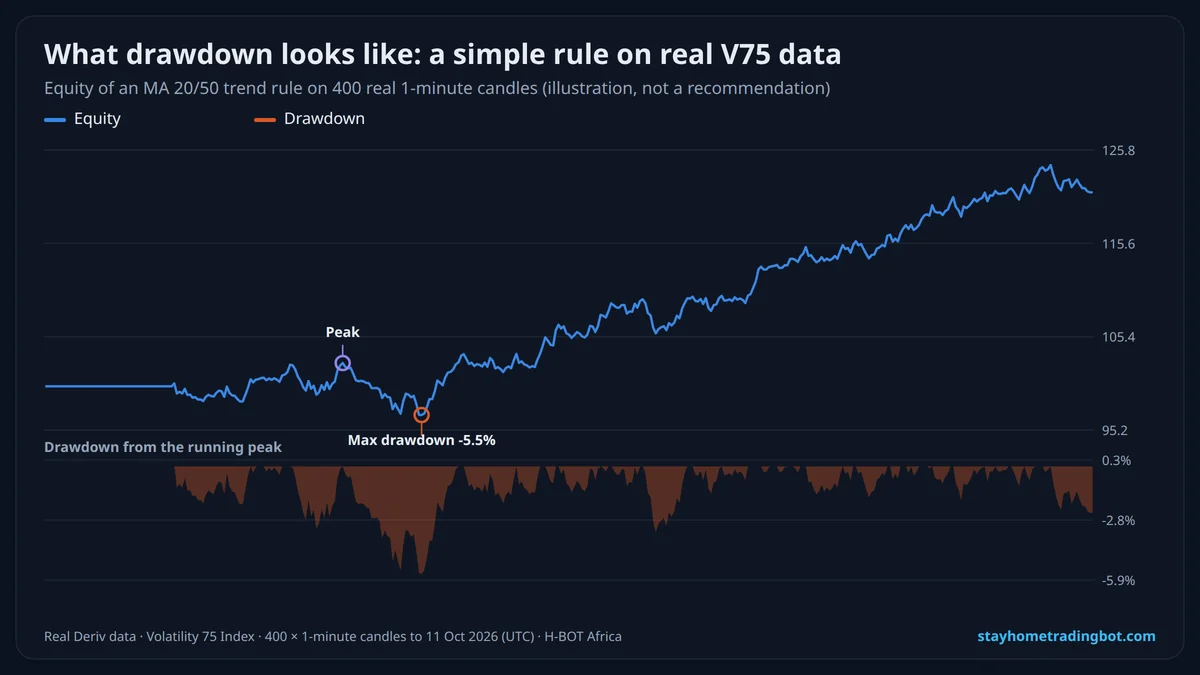
How to Calculate Drawdown
- Track your balance after every trade (or every day).
- Keep a running peak: the highest balance so far.
- Drawdown now = (peak − current balance) ÷ peak.
- Maximum drawdown = the largest drawdown in the whole record.
Excel: with balances in column B from B2, put =MAX($B$2:B2) in C2 (running peak) and =(C2-B2)/C2 in D2 (drawdown), copy down, then =MAX(D:D) gives the maximum drawdown.
Recovery Maths
| Drawdown | Gain needed to get back |
|---|---|
| 10% | 11% |
| 20% | 25% |
| 30% | 43% |
| 50% | 100% |
| 75% | 300% |
How Much Drawdown Is Acceptable?
It depends on you. Many traders stop and review at 10% and set a hard limit near 20% for a personal account. Prop-firm style rules often use daily and overall drawdown limits. What matters is deciding the number before it happens.
How to Limit Drawdown
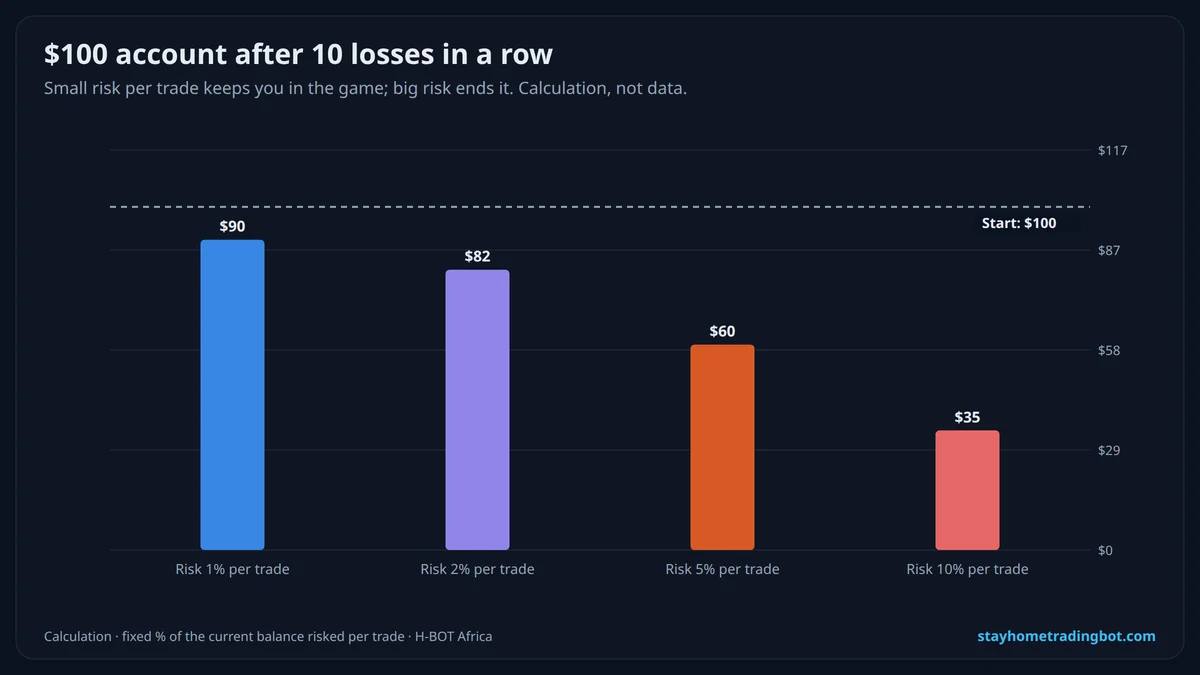
- Risk 1–2% per trade so losing streaks stay shallow.
- Daily loss limit that stops trading for the day.
- No martingale or recovery staking.
- Cut size in half after a 10% drawdown until you recover.
- Review the journal to see whether losses come from the plan or from breaking it.
The H-BOT Analysis and journal shows drawdown for your bot runs. Related: growing a small account.
Try It Free on a $10,000 Demo
Open a free Deriv account, connect it to H-BOT Africa and test bots, signals and digit tools on virtual money before risking a shilling.
Open a free Deriv account Open Deriv Bot Open H-BOT Ask on WhatsApp
Have an audience? Become a Deriv partner and earn commission on clients you refer.
Disclosure: some links on this page are Deriv partner links. If you open an account or become a partner through them, H-BOT Africa may earn a commission at no extra cost to you.
Frequently Asked Questions
What is max drawdown?
The largest fall from a peak balance to a later low, as a percentage of the peak.
How is max drawdown calculated?
(Peak − lowest balance after the peak) ÷ peak × 100, taking the largest value over the period.
How much max drawdown is good?
Lower is better; many personal traders aim to keep it under about 10–20%.
Can max drawdown be positive?
It is usually shown as a positive percentage of loss, or as a negative number; both mean the same.
Why does a 50% loss need a 100% gain?
Because the gain is calculated on the smaller balance left after the loss.
Does max drawdown reset?
In your own records it covers the period you measure; prop firms define their own reset rules.
Related Guides
 Risk Management for Deriv Traders: Stake Size, Stop-Loss and Daily Limits That Protect Your Account
 How to Grow a Small Trading Account Without Blowing It: An Honest PlanStop Loss and Take Profit on Deriv: How to Set Them, Best Ratios and Bot SettingsH-BOT Backtester and Trading Journal: How to Use Them and Read Win Rate, Expectancy and Drawdown