Deriv Vanilla Options Explained: Call and Put, Strike Choice and What Real Ticks Showed
How Vanilla Options Work on Deriv
- Choose Call (up) or Put (down), the market, a duration (from 1 minute on synthetic indices) and your stake.
- Choose the strike: at the current price, or a set distance above or below it.
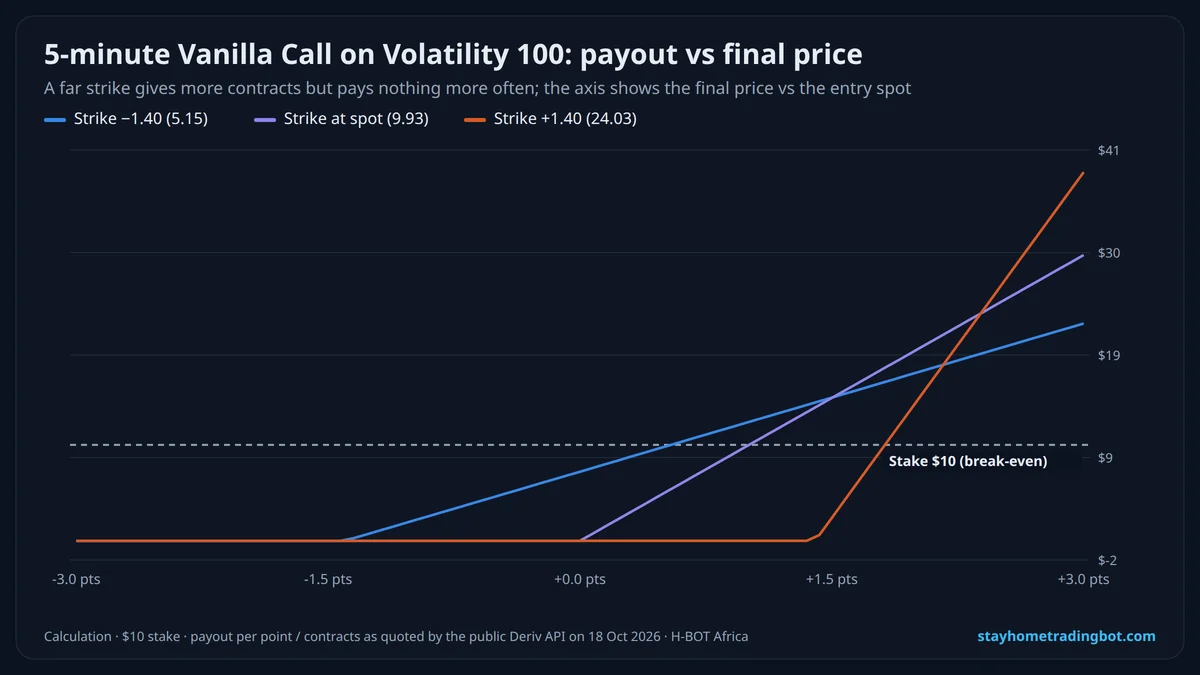
- Deriv shows how many contracts your stake buys. Each contract pays $1 per point past the strike.
- At expiry: payout = contracts × (final − strike) for a Call, or contracts × (strike − final) for a Put. If price ends on the wrong side, the payout is $0.
- You can sell before expiry, up to 60 seconds before it ends.
What Your $10 Bought on 18 October 2026
| 5-minute Call on V100 | Contracts for $10 | Break-even move |
|---|---|---|
| Strike 1.40 below price (in the money) | 5.15 | about +0.54 points |
| Strike at the price | 9.93 | about +1.01 points |
| Strike 1.40 above price (out of the money) | 24.03 | about +1.82 points |
An out-of-the-money strike buys more contracts, so a big move pays a lot, but you need a bigger move just to get your stake back, and most trades pay nothing.
What Happened on Real Volatility 100 Ticks
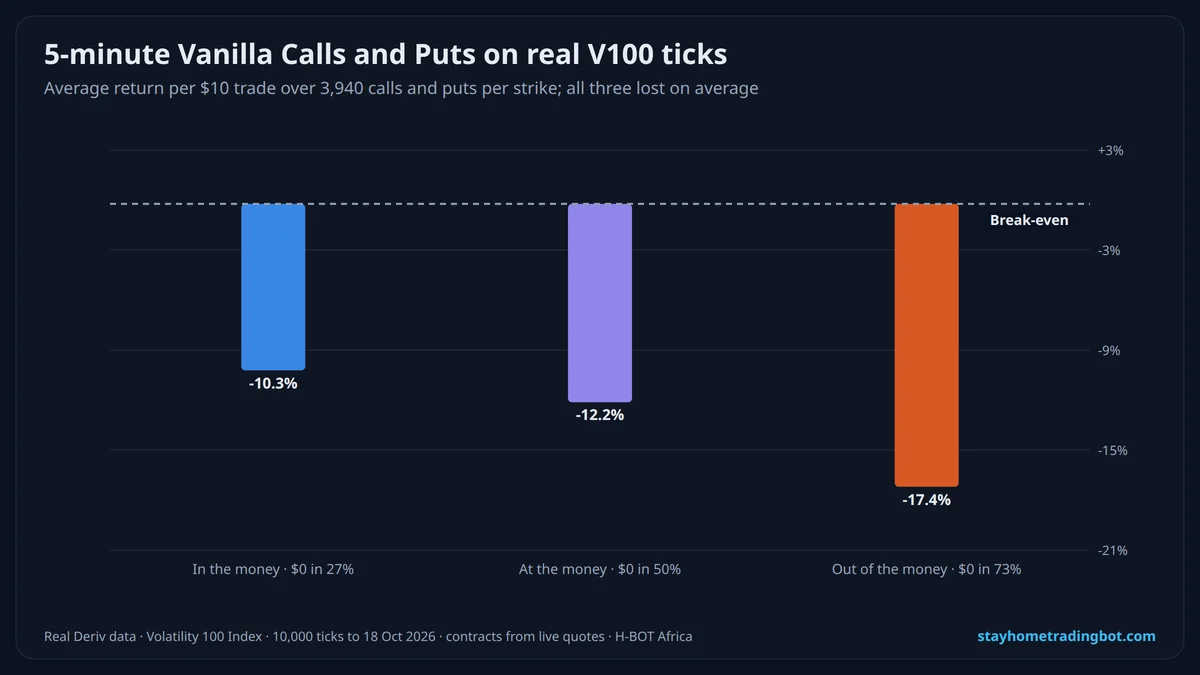
| Strike | Paid more than the stake | Paid $0 | Average return |
|---|---|---|---|
| In the money (−1.40) | 41.0% | 27.4% | −10.3% |
| At the money | 33.9% | 50.2% | −12.2% |
| Out of the money (+1.40) | 21.2% | 72.8% | −17.4% |
We used 10,000 real ticks and bought a Call and a Put every 5 ticks (3,940 trades per strike), so the index’s own drift during the sample does not favour either side.
Vanilla vs Other Deriv Contracts
| Contract | What you win | Main risk |
|---|---|---|
| Rise/Fall | Fixed payout | Price ends on the wrong side |
| Vanilla | Grows with the move | Small moves pay $0 |
| Turbos | Grows with the move | Knock-out barrier |
| Multipliers | Grows with the move | Stop-out on big losses |
Tips Before You Trade Vanillas
- Use Vanillas when you expect a large move, not a small one.
- Compare the break-even move with the normal move for your duration (see {L("atr-indicator-deriv", "ATR")}).
- Keep each stake to 1–2% of your balance.
- Try it on demo; check how often small moves leave you with $0.
Try It Free on a $10,000 Demo
Open a free Deriv account, connect it to H-BOT Africa and test bots, signals and digit tools on virtual money before risking a shilling.
Open a free Deriv account Open Deriv Bot Open H-BOT Ask on WhatsApp
Have an audience? Become a Deriv partner and earn commission on clients you refer.
Disclosure: some links on this page are Deriv partner links. If you open an account or become a partner through them, H-BOT Africa may earn a commission at no extra cost to you.
Frequently Asked Questions
What are vanilla options on Deriv?
Call and Put options whose payout equals contracts × the distance the final price ends past the strike.
What strike should I choose?
Strikes in the money win more often but pay less per point; out-of-the-money strikes pay more per point but lose the whole stake more often.
When do I make a profit with a vanilla option?
Only when the payout is larger than the stake you paid.
Can I sell a vanilla option early?
Yes, up to 60 seconds before expiry, at the contract value Deriv offers.
What is the difference between vanilla and exotic options?
Vanillas are plain calls and puts; exotics add features such as barriers, as in Turbos or Touch contracts.
Did vanillas make money in your test?
No. On real V100 ticks all three strikes lost on average.
Related Guides
 NEWDeriv Turbos Explained: Barriers, Payout per Point and What a Real-Data Test Showed
 Deriv Rise/Fall Strategy: How the Contract Works and How to Trade It Carefully
 Deriv Multipliers Explained: How They Work, Stop-Out, Deal Cancellation and Safer UseVolatility 100 Index: What It Is, V100 vs V100 (1s) vs V50, and How to Trade It