Deriv Turbos Explained: Barriers, Payout per Point and What a Real-Data Test Showed
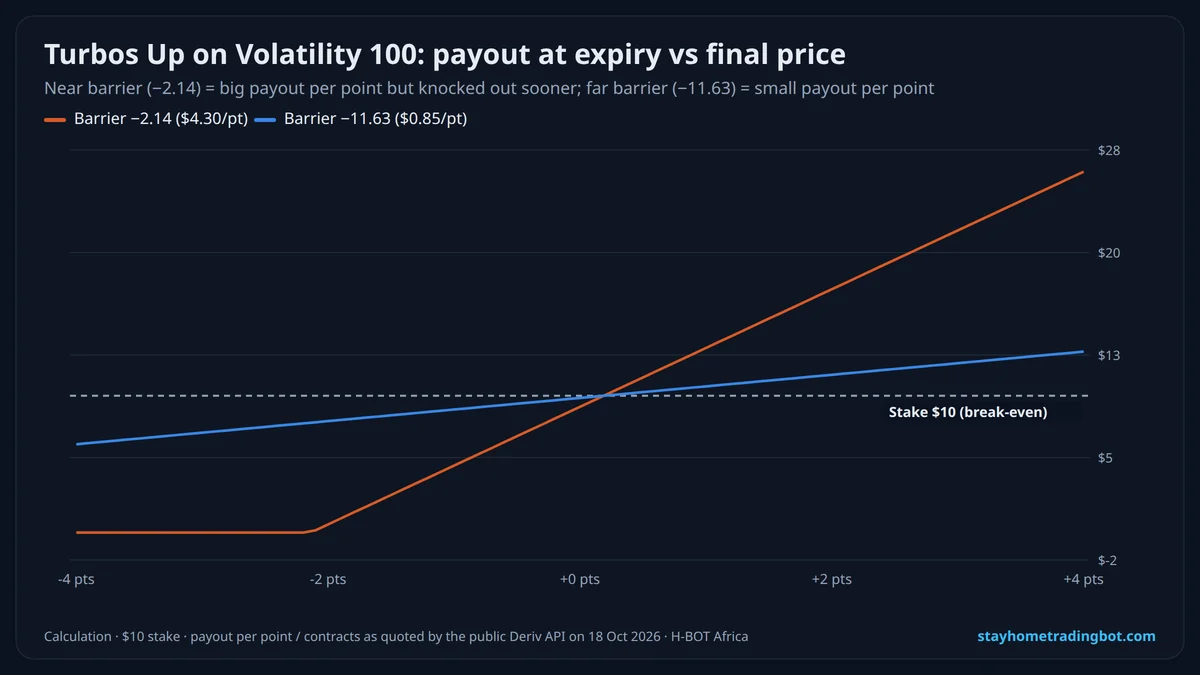
How Deriv Turbos Work
- Pick a market (for example Volatility 100), Up or Down, a duration (from 5 ticks up to days) and a stake.
- Choose a barrier from Deriv’s list. For Up it sits below the price; for Down it sits above.
- Deriv shows the payout per point for that barrier before you buy.
- If price touches the barrier at any time, the contract is knocked out and you lose the stake.
- If not, at expiry you receive payout per point × distance between the final price and the barrier.
What Deriv Quoted on 18 October 2026
| Barrier (Up, V100) | Payout per point ($10 stake) | Price must end above |
|---|---|---|
| −2.14 points | $4.30 | entry + 0.19 |
| −3.76 | $2.53 | entry + 0.19 |
| −6.61 | $1.47 | entry + 0.19 |
| −11.63 | $0.85 | entry + 0.19 |
| −36.03 | $0.28 | entry + 0.19 |
Notice the last column. Whatever barrier you choose, the price must finish about 0.19 points above the entry just to get your $10 back. That 0.19 is Deriv’s built-in cost. The barrier only changes how big the win or loss is per point, and how easily you are knocked out.
What Happened on Real Volatility 100 Ticks
We replayed 10,000 real V100 ticks (about 5.5 hours) and opened Up and Down Turbos with the quoted payout per point every 3 ticks.
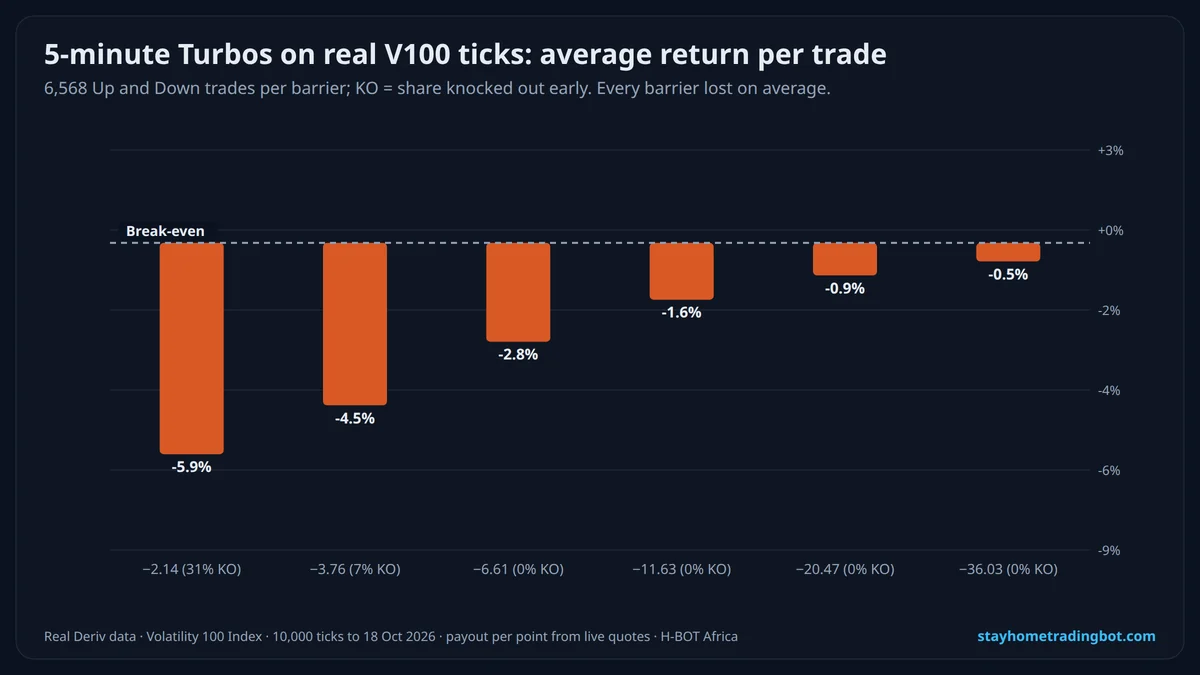
| Barrier | 5 ticks: return | 5 minutes: knocked out | 5 minutes: return |
|---|---|---|---|
| −2.14 | −8.1% | 30.6% | −5.9% |
| −3.76 | −4.8% | 6.5% | −4.6% |
| −6.61 | −2.8% | 0% | −2.8% |
| −11.63 | −1.6% | 0% | −1.6% |
| −36.03 | −0.5% | 0% | −0.5% |
The closer the barrier, the bigger the cost per trade, because the fixed 0.19-point cost is a bigger share of a small distance. Far barriers cost less but also pay very little per point, so they behave like a slow, small directional bet.
A Safer Way to Use Turbos
- Treat Turbos as a direction trade, not a lottery: decide the direction with a reason, such as a trend filter ({L("moving-average-strategy-deriv", "moving averages")}).
- Prefer barriers further than the normal move for your duration. Check the {L("atr-indicator-deriv", "ATR")} to see the normal move.
- Risk 1–2% of your balance per trade and stop after a set number of losses.
- Practise on the demo account first; Turbos with tick durations cannot be sold early.
Try It Free on a $10,000 Demo
Open a free Deriv account, connect it to H-BOT Africa and test bots, signals and digit tools on virtual money before risking a shilling.
Open a free Deriv account Open Deriv Bot Open H-BOT Ask on WhatsApp
Have an audience? Become a Deriv partner and earn commission on clients you refer.
Disclosure: some links on this page are Deriv partner links. If you open an account or become a partner through them, H-BOT Africa may earn a commission at no extra cost to you.
Frequently Asked Questions
What are Turbos on Deriv?
Contracts that pay payout per point × (final price − barrier) at expiry, unless price touches the barrier first, which knocks them out.
How do I choose a Turbos barrier?
Closer barriers pay more per point but are knocked out more often; pick one beyond the normal move for your duration.
Can Turbos make money?
Some trades win, but in our real-data test every barrier lost on average because of the built-in cost.
What is payout per point?
How many dollars you receive for each point the final price is beyond the barrier.
Can I close a Turbo early?
Yes for minute and longer durations; tick-based Turbos run to expiry.
Are Turbos the same as multipliers?
No. Multipliers have stop-out and optional stop loss; Turbos have a fixed barrier and expiry.
Related Guides
 NEWDeriv Vanilla Options Explained: Call and Put, Strike Choice and What Real Ticks Showed
 Deriv Multipliers Explained: How They Work, Stop-Out, Deal Cancellation and Safer Use
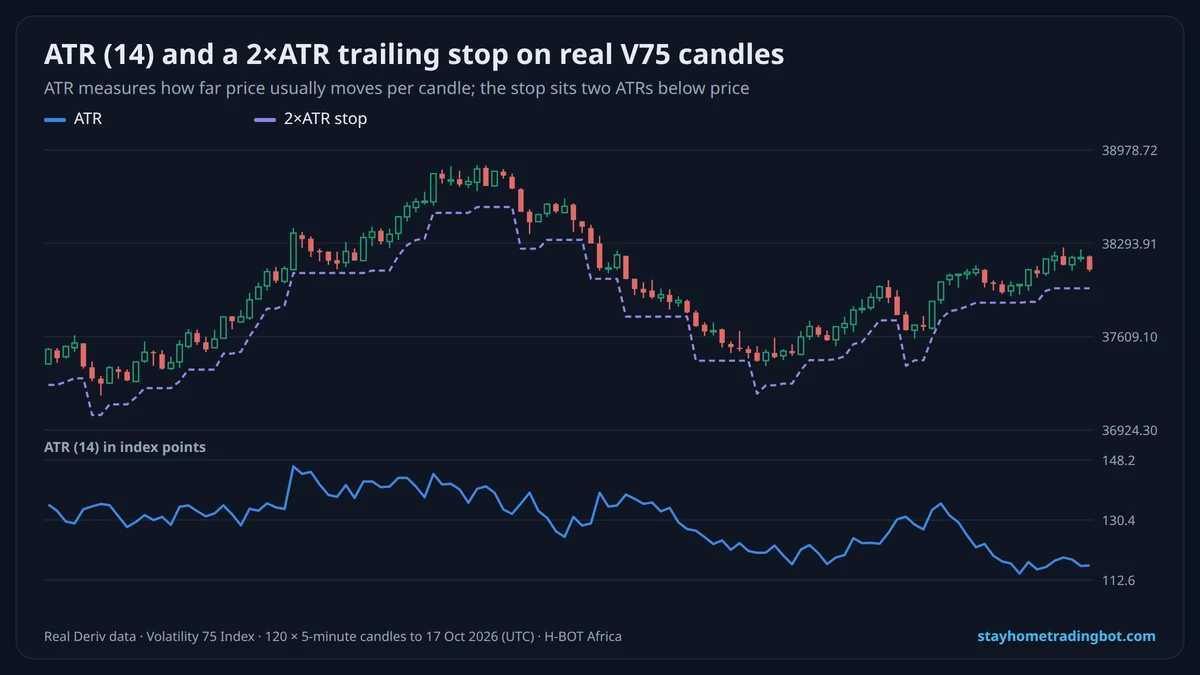 NEWATR Indicator for Deriv Traders: How to Read It and Set Stop Losses With It
 Risk Management for Deriv Traders: Stake Size, Stop-Loss and Daily Limits That Protect Your Account