Deriv Higher/Lower: How Barriers Work and How to Choose Them
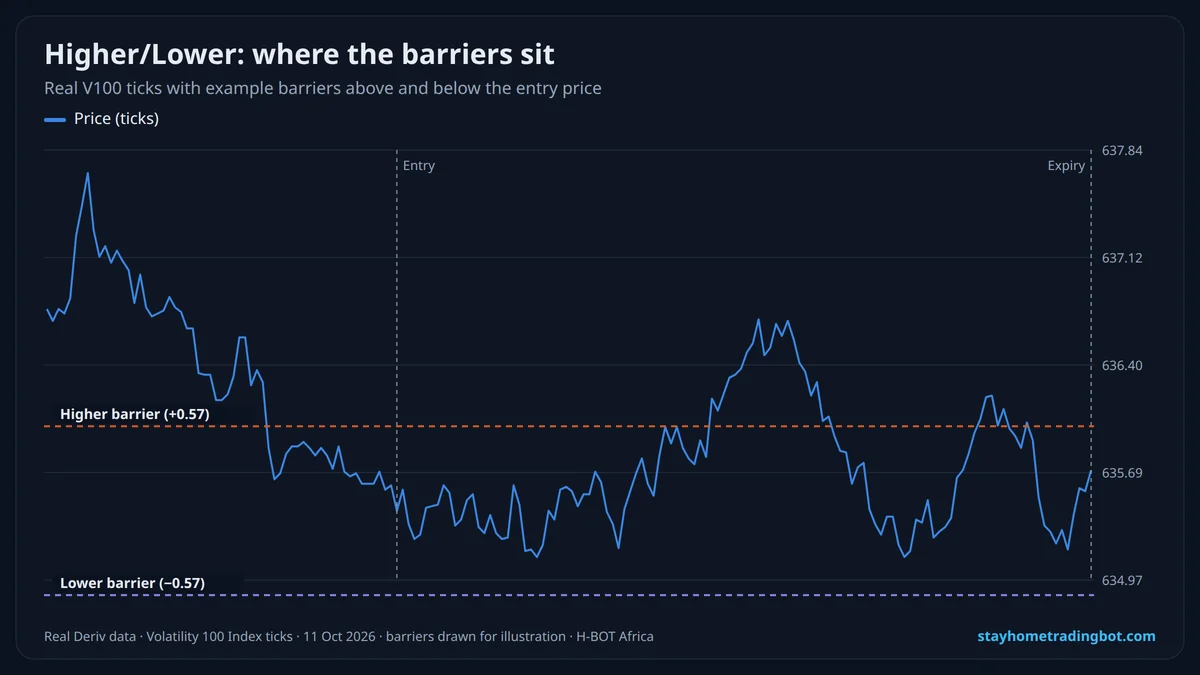
Higher/Lower vs Rise/Fall
| Rise/Fall | Higher/Lower | |
|---|---|---|
| Barrier | The entry price | You choose an offset |
| Payout | Fixed by duration | Changes with barrier distance |
| Flexibility | Low | High |
How Barrier Distance Changes the Odds
| Choice | Win chance | Payout |
|---|---|---|
| Higher with barrier below price | High | Low |
| Higher with barrier above price | Lower | Higher |
| Lower with barrier above price | High | Low |
Break-Even Win Rate
If a win returns 30% of the stake, you must win about 77% of trades just to break even (stake ÷ (stake + profit)). Write this number down for every setting you test.
Choosing a Barrier
- Use support and resistance for direction.
- Match the barrier to the index’s speed (V10–V100 speeds).
- Keep stake fixed while testing.
A Demo Practice Plan (One Week)
- Day 1: record payouts for three barrier offsets on V100.
- Day 2: calculate the break-even win rate for each.
- Day 3–5: 30 demo trades per setting with a fixed stake.
- Day 6–7: keep only settings whose real win rate beats break-even.
Common Mistakes
- Chasing high payouts with far barriers.
- Ignoring index speed when choosing offsets.
- Martingale after losses.
Try It Free on a $10,000 Demo
Open a free Deriv account, connect it to H-BOT Africa and test bots, signals and digit tools on virtual money before risking a shilling.
Open a free Deriv account Open Deriv Bot Open H-BOT Ask on WhatsApp
Have an audience? Become a Deriv partner and earn commission on clients you refer.
Disclosure: some links on this page are Deriv partner links. If you open an account or become a partner through them, H-BOT Africa may earn a commission at no extra cost to you.
Frequently Asked Questions
What is Higher/Lower on Deriv?
A contract that wins if the exit price is above (Higher) or below (Lower) a barrier you set.
How is Higher/Lower different from Rise/Fall?
Rise/Fall uses the entry price as the barrier; Higher/Lower lets you move it.
Which barrier should I use?
One whose payout and realistic win rate beat the break-even rate in your demo tests.
How do I calculate break-even?
Stake ÷ (stake + profit per win).
Is Higher/Lower easier than Rise/Fall?
It is more flexible, not easier; payouts adjust to the odds.
Can I automate Higher/Lower?
Yes, in Deriv Bot; test on demo first.
Related Guides
 Deriv Rise/Fall Strategy: How the Contract Works and How to Trade It Carefully
 Deriv Touch/No Touch: How Barriers Work and How to Choose Them
 Support and Resistance on Deriv: How to Draw Levels and Trade Them Safely
 Risk Management for Deriv Traders: Stake Size, Stop-Loss and Daily Limits That Protect Your Account